1. Introduction
I've been specifying electrical insulation components for about fifteen years now, and if there's one thing I've learned, it's this: the cheapest sleeve on the market is almost never the cheapest in the long run.
Here's what I mean. A few years back, I was working with a motor manufacturer who had been using acrylic-coated fiberglass sleeving for years without issues. Then they switched suppliers to save a few cents per unit, and within six months, their field failure rate had tripled. The new sleeves looked identical, but the acrylic coating was slightly thinner and couldn't handle the thermal cycling. The company ended up spending more on warranty claims and emergency replacements than they'd ever saved.
Electrical insulation sleeving is one of those components that doesn't get a lot of attention—until it fails. And when it fails, the consequences can be serious: electrical shorts, equipment damage, production downtime, and in worst-case scenarios, safety incidents.
The global electrical insulation sleeving market was valued at approximately USD 1.2 billion in 2023 and is projected to reach USD 2.1 billion by 2032, growing at a CAGR of 6.5%. The coated braided fiberglass sleeving segment alone was valued at USD 342.5 million in 2023 and is projected to reach USD 487.2 million by 2030. The insulating sleeving market more broadly (covering thermal protection applications) was valued at USD 2.31 billion in 2024 and is projected to reach USD 3.35 billion by 2032.
That growth is being driven by electric vehicle production, renewable energy infrastructure, and increasingly stringent safety regulations. And with that growth comes more choices—which means more opportunities to get the selection wrong.
So let's talk about how to choose the right material for your application. Because getting this right isn't just about specs on a datasheet—it's about reliability, safety, and actually saving money over the life of your equipment.
2. Understanding the Material Landscape
Before we dive into specific materials, let's establish some basic context.
Electrical insulation sleeving is essentially a protective tube that goes over wires, cables, busbars, or other conductive components. It provides three main functions:
Electrical insulation – prevents shorts and leakage currents
Thermal protection – shields components from heat damage
Mechanical protection – guards against abrasion, moisture, and chemicals
The sleeving can be either heat-shrinkable (which contracts when heated to form a tight fit) or non-heat-shrinkable (which maintains its original diameter). Most of what I'll cover here focuses on non-heat-shrinkable fiberglass-based sleeving, which is the most common type for industrial and automotive applications.
The basic construction of fiberglass sleeving starts with E-glass yarns braided into a flexible tube. That bare braid provides mechanical strength but little electrical insulation on its own. A coating resin—typically silicone, acrylic, PVC, or polyurethane—is applied and cured to saturate the braid. The coating is what determines the sleeving's temperature rating, dielectric strength, and chemical compatibility.
Here's the key point: The fiberglass is the skeleton. The coating is the muscle. You can have two sleeves that look identical but perform completely differently because of what's on the outside.
3. Silicone-Coated Fiberglass Sleeving – The Premium Choice
If you're working in high-temperature or demanding environments, silicone-coated fiberglass sleeving is usually the right answer. I know it's more expensive, but let me explain why it's often worth the premium.
Silicone rubber coating is applied over a braided fiberglass substrate. The silicone's inorganic chemical structure gives it superior thermal stability and UV resistance compared to carbon-based polymers.
Temperature Performance: Silicone-coated fiberglass sleeving is typically rated to Class H (180°C), with some specialized compounds reaching 200°C or higher. Synflex's H/GS SV6 UL sleeving, for example, is applicable for temperature ranges between -60°C and +250°C. Volsun's silicone fiberglass sleeving offers continuous operation from -40°C to 200°C. Some products can even handle short-term peaks up to 290°C.
Dielectric Strength: Silicone-coated sleeves typically offer dielectric breakdown voltages of 1.5kV, 2.5kV, 4kV, or 7kV depending on wall thickness. Synflex's H/GS SV6 UL achieves a minimum of 7kV.
Flame Retardancy: Silicone is inherently self-extinguishing and often meets stringent flammability standards like UL VW-1 without extensive additives. Many silicone fiberglass sleeves are UL 1441 certified with VW-1 flammability ratings.
Flexibility: This is one of silicone's standout features. It remains highly elastic and flexible even at extreme temperatures—both high and low. That matters when you're installing sleeving in tight spaces or on complex geometries.
Chemical and Environmental Resistance: Silicone-coated sleeving shows good resistance to UV, transformer oils, and liquid fuels. It's also halogen-free and often watertight. Silicone maintains its dielectric performance even after prolonged moisture exposure due to its hydrophobic properties.
The Trade-off: Silicone is expensive—typically 2–4× the cost of acrylic-coated alternatives. But for applications where reliability matters, that extra cost is usually justified.
4. Acrylic-Coated Fiberglass Sleeving – The Cost-Effective Alternative
Acrylic-coated fiberglass sleeving is produced by applying an acrylic resin varnish to a fiberglass braid. The acrylic coating is a thermoplastic that's prized for its electrical properties and is often chosen as a cost-effective alternative when the absolute highest temperature resistance isn't required.
Temperature Performance: Acrylic-coated sleeving is typically rated to Class F (155°C), or in some cases Class B (130°C). The operating temperature is stable and reliable below 150°C.
Dielectric Strength: Acrylic sleeving typically boasts a higher initial dielectric strength at room temperature compared to silicone. However—and this is important—that advantage diminishes rapidly as the temperature approaches the material's limit. The thermoplastic nature of the acrylic binder softens, causing a drop in insulating capability.
Mechanical Protection: The hard, tough nature of cured acrylic coating provides strong mechanical protection and good abrasion resistance.
Flame Retardancy: Acrylic requires fire-retardant additives to meet VW-1 standards. When it burns, acrylic releases more smoke and potentially more toxic fumes than silicone—an important consideration for enclosed environments like transit vehicles or aircraft.
The Catch: When exposed to temperatures significantly above its rating for extended periods, acrylic coating undergoes thermal degradation, becoming hard and brittle. Once cracked, the underlying fiberglass braid is exposed, leading to catastrophic loss of insulation integrity. Silicone, by contrast, maintains its elastic properties far beyond the point where acrylic fails.
Best Use Cases: Acrylic-coated sleeving is ideal for applications where temperatures stay consistently below 150°C and cost is a primary concern—motors, transformers, generators, and general electrical equipment.
5. PVC Sleeving and Other Options
PVC (Polyvinyl Chloride) Sleeving: PVC is an economical and flame-retardant material commonly used in general-purpose electrical wiring. Operating temperature is typically up to 105°C (Class B). It's self-extinguishing, available in many colors, and easy to extrude for mass production. PVC sleeves are ideal for household appliances, switchgear, and electronics. If your application stays under 105°C and doesn't involve extreme environments, PVC can be a perfectly adequate and cost-effective choice.
Polyolefin Heat Shrink Tubes: Polyolefin-based heat shrink tubing provides mechanical sealing and insulation through heat activation. Temperature resistance typically reaches 125–135°C. These tubes shrink to a tighter fit when heated, offering waterproofing and strain relief. They're widely used in cable repair, terminations, and harnessing.
PET Braided Sleeving: PET (polyester) braided sleeving is used for abrasion protection and cable management rather than primary electrical insulation. It offers excellent abrasion and chemical resistance, is expandable and lightweight, and is ideal for EV and industrial control systems.
PTFE and High-Performance Materials: For extreme conditions, materials like PTFE (Teflon), PEEK, and ceramic fiber offer thermal resistance up to 250–260°C. They're chemically inert and highly durable, common in aerospace, defense, and nuclear applications.
Here's a comparison table to help visualize the trade-offs:
Material | Temperature Class | Max Continuous Temp | Dielectric Strength | Flame Retardant | Flexibility | Relative Cost |
Fiberglass (Silicone) | Class H | 180–200°C | High (1.5–7kV) | Yes (UL VW-1) | Moderate-High | High |
Fiberglass (Acrylic) | Class F | 155°C | High (initial) | Yes (with additives) | Moderate | Low-Medium |
Fiberglass (PVC) | Class B | 105°C | Medium | Yes | High | Low |
Silicone Rubber | Class H | 200°C | Medium (28 kV/mm) | Yes | High | High |
Polyolefin | Class B–F | 125–135°C | Medium | Yes | Moderate | Low-Medium |
PTFE | Class C | 250°C | Very High | Yes | Low | Very High |
Sources: IsoMaterial, PaperInsulation, Volsun
6. Key Selection Criteria: Temperature, Voltage, and Environment
So how do you actually make a decision? Here's the framework I use with my clients.
Step 1: Know Your Operating Temperature. This is the single most important factor. What's the maximum continuous temperature your sleeving will experience? What about short-term peaks? If you're under 105°C, PVC might work. Under 155°C? Acrylic could be fine. Above 155°C or with frequent thermal cycling? You need silicone or a high-performance material.
Step 2: Determine Your Voltage Requirements. Dielectric breakdown voltage is typically 1.5kV to 7kV depending on wall thickness and material. Volsun offers multiple dielectric strength options including 1500V, 2500V, 4000V, and 7000V versions. Higher voltage applications require thicker walls or higher-grade materials.
Step 3: Consider the Environment. Will the sleeving be exposed to moisture, chemicals, oils, or UV? Silicone performs well in all of these. Acrylic is less moisture-resistant. If you're in a high-humidity environment or outdoor application, silicone is usually the safer bet.
Step 4: Check Certification Requirements. Do you need UL recognition? UL 1441 is the key standard for coated electrical sleeving. Many buyers require UL-recognized components as a condition of purchase. Do you need RoHS or REACH compliance? Most major manufacturers now offer certified products.
Step 5: Factor in Installation. Silicone is more flexible and easier to install in tight spaces. Acrylic is stiffer but offers better abrasion resistance. If your installation involves sharp bends or complex routing, silicone's flexibility is a real advantage.
Step 6: Calculate Total Cost of Ownership. This is where many procurement teams get it wrong. The cheapest sleeve might save you a few cents per unit but cost you thousands in field failures. Consider the cost of replacement, downtime, warranty claims, and reputational damage. The buyer's decision-making process is increasingly influenced by total cost of ownership rather than unit price alone.
7. Real-World Application: EV Battery Busbar Protection
Let me share a case that illustrates why material selection matters.
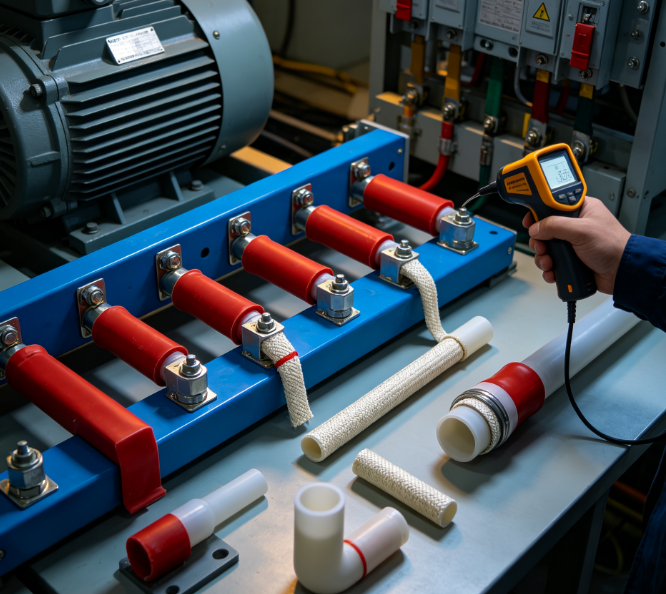
The Challenge: Electric vehicle battery systems operate at high voltages and generate significant heat. Busbars—conductive metallic strips used for power distribution—need insulation that can withstand both electrical stress and thermal cycling. Traditional methods involved wrapping busbars with tape or using multi-layer insulation systems. Labor-intensive, time-consuming, and not always reliable.
The Solution: TE Connectivity developed the VOLINSU EVBB heat shrink tubing specifically for high-current busbar applications. The tubing is ideal for automotive EV busbars, industrial and commercial transportation EV busbars, electric control, and battery cells.
But here's another interesting example. A Chinese EV manufacturer was using acrylic-coated sleeving for their battery management system wiring. It met the temperature requirements on paper—155°C rating, and the system operated at about 130°C. But the thermal cycling—repeated heating and cooling during charge/discharge cycles—caused the acrylic coating to become brittle and crack over time. Moisture got in, corrosion followed, and they started seeing insulation failures.
The Fix: They switched to silicone-coated fiberglass sleeving. The silicone maintained its flexibility through thousands of thermal cycles. The hydrophobic properties kept moisture out. The dielectric strength remained consistent across the entire temperature range. The result? Failure rates dropped by over 80%.
The Lesson: Temperature rating alone isn't enough. You have to consider how the material behaves under real-world conditions—thermal cycling, moisture exposure, vibration, and aging. Silicone's superior aging resistance and stability under thermal stress made all the difference.
Another example: Dongguan Liansi Electronics partnered with BYD and XPeng Motors to provide S7 self-wrapping braided sleeves for electric vehicle battery management systems, offering superior electrical insulation, moisture resistance, and ease of installation in humid and vibration-prone environments.
8. Common Questions About Electrical Insulation Sleeving (FAQ)
Q: What's the difference between silicone-coated and acrylic-coated fiberglass sleeving?
The short answer: silicone handles higher temperatures (200°C vs 155°C), maintains flexibility under thermal cycling, and is more moisture-resistant. Acrylic is more cost-effective and offers good abrasion resistance. If your application runs below 155°C and doesn't involve extreme thermal cycling or moisture, acrylic is usually the more economical choice.
Q: What does "VW-1" mean and why does it matter?
VW-1 is a flame test standard under UL 1441. It requires the sleeving to be self-extinguishing when tested in a vertical position. Many electrical codes and safety regulations require VW-1-rated materials. Silicone fiberglass sleeves typically achieve VW-1 with <30-second self-extinguishing time.
Q: Can electrical insulation sleeving withstand moisture and outdoor conditions?
It depends on the material. Silicone maintains dielectric performance after prolonged moisture exposure due to its hydrophobic properties. Acrylic is less moisture-resistant. For outdoor or high-humidity applications, specify silicone-coated products or materials specifically rated for environmental exposure.
Q: What voltage ratings are available for fiberglass sleeving?
Electrical insulation fiberglass sleeving is available in multiple dielectric strength levels, including 1.5kV, 2.5kV, 4kV, and 7kV, meeting different insulation requirements. Higher ratings generally require thicker walls.
Q: How do I choose the right diameter?
For non-heat-shrinkable sleeving, the internal diameter should be slightly larger than the maximum diameter of the component you're covering. For heat-shrinkable, you need to consider both the expanded diameter (to fit over the component) and the recovered diameter (to ensure a tight fit after shrinking). Synflex offers inner diameters from 0.5mm to 50mm with precise tolerances.
Q: What certifications should I look for?
At minimum: UL recognition (UL 1441 for sleeving), RoHS compliance, and REACH compliance. Depending on your industry, you may also need specific certifications like IATF 16949 for automotive applications.
9. Final Thoughts
Look, I'll be honest—choosing the right electrical insulation sleeving isn't glamorous work. But in my years in this industry, I've seen too many failures that could have been prevented with better material selection.
Here's what I've learned:
Don't just spec by temperature rating. Thermal cycling, moisture, chemicals, and mechanical stress all matter just as much.
Don't assume cheaper is better. The cost difference between acrylic and silicone might be a few cents per unit, but the cost of a field failure can be thousands of dollars—not to mention the reputational damage.
Do your homework on certifications. UL 1441, RoHS, REACH—these aren't just boxes to check. They're evidence that the product has been tested and verified.
Test before you commit. If possible, run samples through your actual production process and operating conditions. Theory and reality don't always align.
The market is growing for good reason. The global electrical insulation sleeving market is projected to reach USD 2.1 billion by 2032. The insulating sleeving market is growing at 4.2% CAGR through 2032. EV production, renewable energy infrastructure, and stricter safety regulations are driving demand.